The core difference
| Question | CAGR | IRR |
|---|---|---|
| What does it use? | Beginning value, ending value, time | A sequence of cash flows |
| Does cash-flow timing matter? | No intermediate flows are modeled | Yes, by periodic position |
| Typical use | Revenue, users, portfolio value endpoints | Projects and investments with periodic cash flows |
| Excel function | Direct formula or RRI | IRR(values, [guess]) |
CAGR formula
CAGR asks what constant annual compound rate would connect two endpoint values:
CAGR = (Ending Value ÷ Starting Value)^(1 ÷ Years) − 1
For example, a value that moves from $10,000 to $16,000 over four years has a CAGR of about 12.47%. The calculation ignores the path between those endpoints.
What IRR is solving
IRR works differently. It looks for the rate that makes the net present value of a series of cash flows equal to zero. Microsoft describes Excel's IRR function as applying to cash flows that occur at regular intervals, such as monthly or annually.
That makes IRR appropriate when the cash-flow sequence is part of the question. A project might begin with a large negative cash flow and then generate positive cash flows over several periods. CAGR cannot represent that structure with only a beginning and ending value.
Example: why the measures answer different questions
Suppose an investment starts at $10,000 and is worth $16,000 four years later. If there were no additional deposits or withdrawals, CAGR summarizes the endpoint growth cleanly.
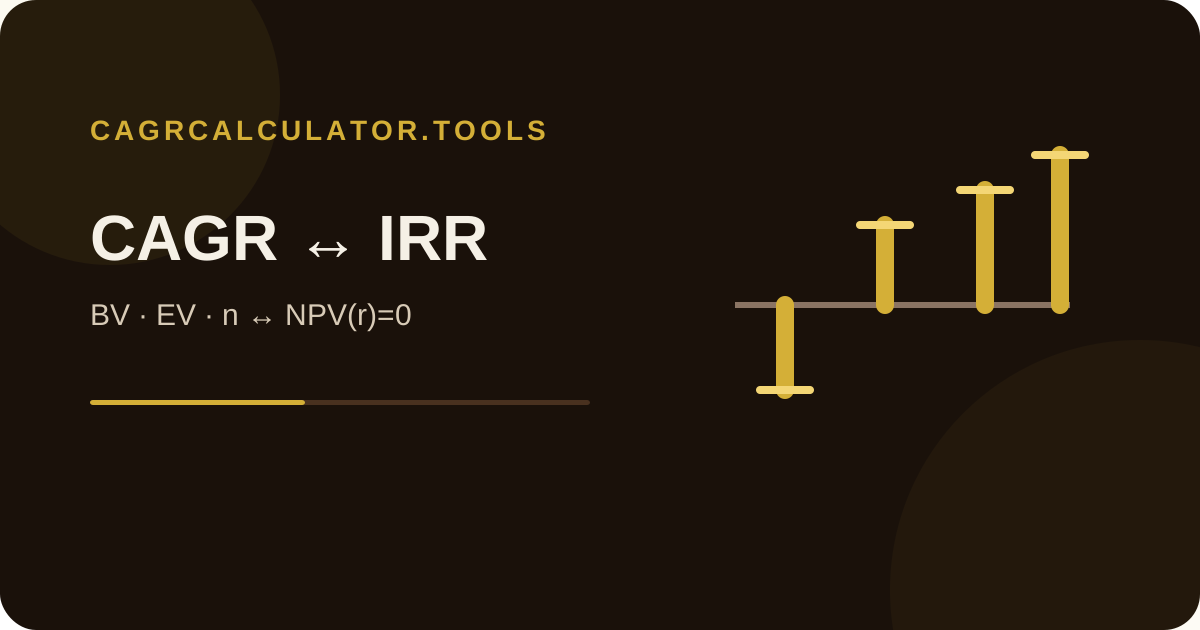
Now change the scenario: invest $10,000 initially, receive $1,500 after year one, $2,500 after year two, $3,000 after year three, and $8,000 after year four. The cash-flow stream is now central to the return calculation. IRR can model those periodic flows; a simple CAGR of the first and last numbers cannot.
IRR vs XIRR
IRR assumes the cash flows are equally spaced. If the actual dates are irregular, use XIRR instead. Microsoft's XIRR documentation explicitly describes XIRR as the internal rate of return for a schedule of cash flows that is not necessarily periodic and discounts later payments using a 365-day year.
In practical terms: yearly project cash flows can fit IRR; deposits and withdrawals on specific calendar dates usually fit XIRR better.
When CAGR and IRR may look similar
If there is one initial outflow, one final inflow, no intermediate cash flows, and the timing convention lines up, an IRR-style calculation and an endpoint annualized calculation can converge to the same economic rate. That does not make the formulas interchangeable in more complex cash-flow cases.
Which should you use?
- Use CAGR for company revenue growth, user growth, asset values, or another metric with one beginning and one ending value.
- Use IRR when there are multiple cash inflows and outflows at regular intervals.
- Use XIRR when those cash flows happen on specific irregular dates.
Limitations
CAGR smooths the path and does not show volatility. IRR can be sensitive to the pattern of cash flows and can produce unintuitive or multiple solutions in some non-standard cash-flow patterns. Neither metric should be treated as a complete investment decision on its own.